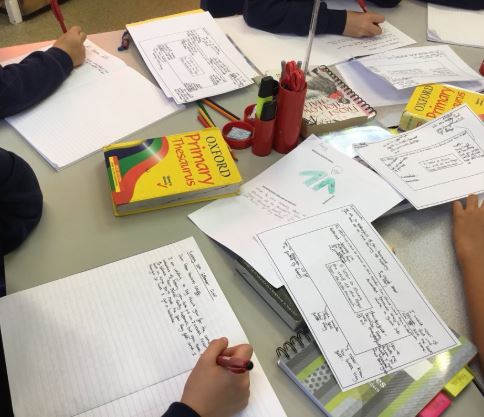
This is an example of an approach to a text, which is designed specifically to help all pupils to develop their writing of literary narrative without recourse to the ‘features of descriptive writing’ or to checklists of literary devices. Over a series of sessions, it integrates whole-class reading practice with the planning and drafting of... Continue Reading →
Re-thinking ‘success criteria’: a simple device to support pupils’ writing
Colleagues and I have been working with primary schools to develop an alternative to listed ‘success criteria’ for writing, which we call ‘boxed’ or ‘expanding success criteria' (or often just 'the rectangles thing.') It is very easy to adopt, and teachers have been finding that it can transform how writing is talked about and approached... Continue Reading →
Whole-class reading: a planning tool
See also Whole-class reading: an example lesson and a menu of approaches and Whole-class reading: another example lesson Recently, colleagues and I have been working hard with schools to develop whole-class reading practice which is both challenging and inclusive. This is a particularly current issue in primary schools, but is - of course - also pertinent to... Continue Reading →
The primary English subject leader: overseer, monitor, director or trusted expert?
Recently, as part of our work with English subject leaders from across the county, the North Yorkshire English Advisory Team have been looking at how the subject is led differently in primary schools. English or literacy subject leaders tend to be talked about as a group, yet we know that what they actually do varies... Continue Reading →
Fear of grammar and the grammar of fear
Injecting challenge at Key Stages 3 and 4, using Key Stage 2 knowledge about grammar The not-so-new-now grammar curriculum at Key Stage 2 has resulted in pupils arriving in secondary school with a knowledge of grammatical terms which, even to some specialist English teachers, can be a little intimidating. It can also be confusing to... Continue Reading →
Whole-class reading: another example lesson
See also: Whole-class reading: a planning tool A description of a recent whole-class reading lesson, with commentary This is a description of another successful whole-class reading lesson which I taught recently to Year 4 and Year 5 classes (although the approaches are applicable to other phases.) It is a follow-up to a post last year... Continue Reading →
Challenging responses: designing a successful teacher-led reading lesson
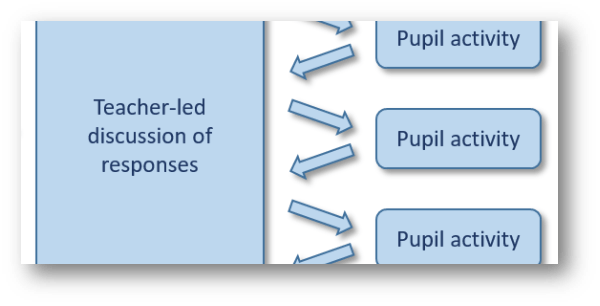
A reflection on some different ways to structure discussion of a text in the classroom. The example is from Key Stage 3, although the principles are applicable to any phase. The text below is one which we used to read with Key Stage 3 pupils at Parkside Community College, in Cambridge, when teaching about World... Continue Reading →
Mini-whiteboard jigsaws
An organising technique and resource for discussion. Good for revision, for practising retrieval and for deepening thinking. (Good for all ages, too.) Step 1 Using sharp scissors, cut up some mini-whiteboards to make a set of unique, four-piece jigsaws, like this. (This is surprisingly quick and easy to do, and oddly satisfying.) You now have... Continue Reading →
Whole-class reading: an example lesson and a menu of approaches
See also: Whole-class reading: a planning tool See also: Whole-class reading: another example lesson See also: Challenging responses: designing a successful teacher-led reading lesson In primary schools recently, there has been a lot of interest in ways to approach whole-class reading lessons. The imperative to raise standards in reading is leading many to question the dominance of... Continue Reading →
Avoiding a ‘literacy dip’ in Year 7
Some questions for secondary teachers, English teams and school leaders, which may be helpful Many secondary schools have concerns about how to maintain progress in the core area of literacy from Year 6 to Year 7, perceiving that many students do not make sufficiently-strong progress in Year 7, or that they can even regress in... Continue Reading →