
I see a lot of explaining happening in classrooms, and I did a lot of explaining as a teacher. It’s a key aspect of instruction, which has been much theorised and written about. For what it’s worth, this is how I see the anatomy of explanation – its mechanical elements and its hugely important (but less discussed) relational elements.
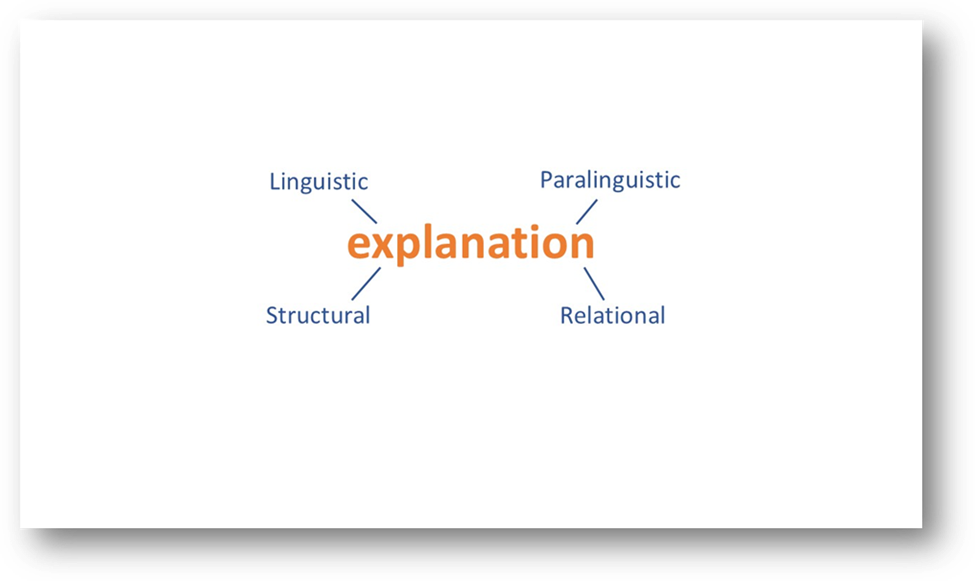
Very broadly, the effectiveness of a classroom explanation depends on four aspects: the language selected, the methods of explanation used, the way the teacher speaks, and the degree to which they have connected with their listeners.
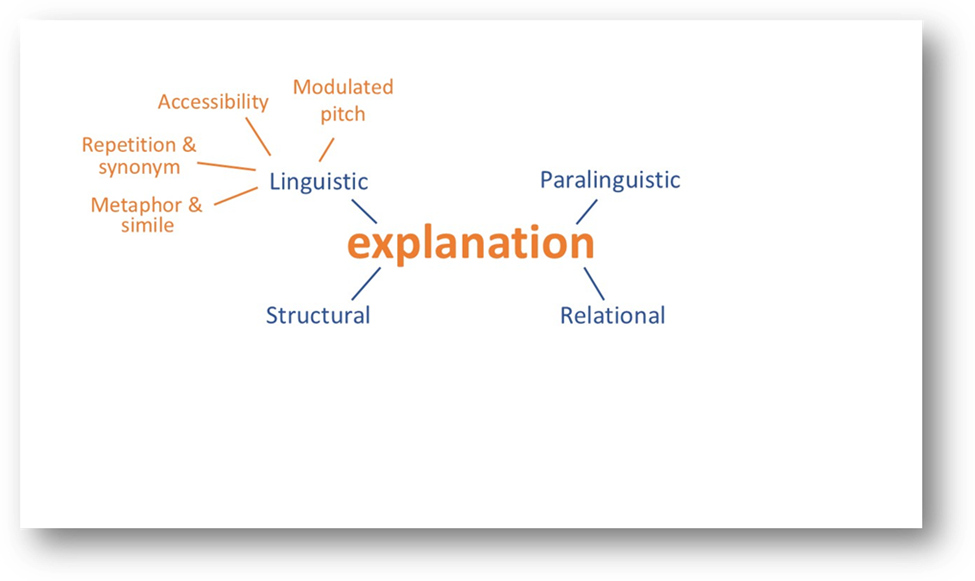
The linguistic dimension – the choice of words used – is largely about pitch and accessibility. Teachers are experts at controlling the pitch, so that meaning is graspable. This often means finding multiple ways of expressing the same ideas, glossing with synonyms (“near the boundary – the edge…”) It is also about using figurative language (“The particles want to move…”; “The ‘volta’ is like a pivot or a turning point in the poem…”, “…the Cold War chess game, which…”, “…the brain, like a command centre…”) The fluency with which teachers do this constant translating comes, of course, from secure subject knowledge – the sort of subject knowledge which holds and can easily access multiple representations of an idea.
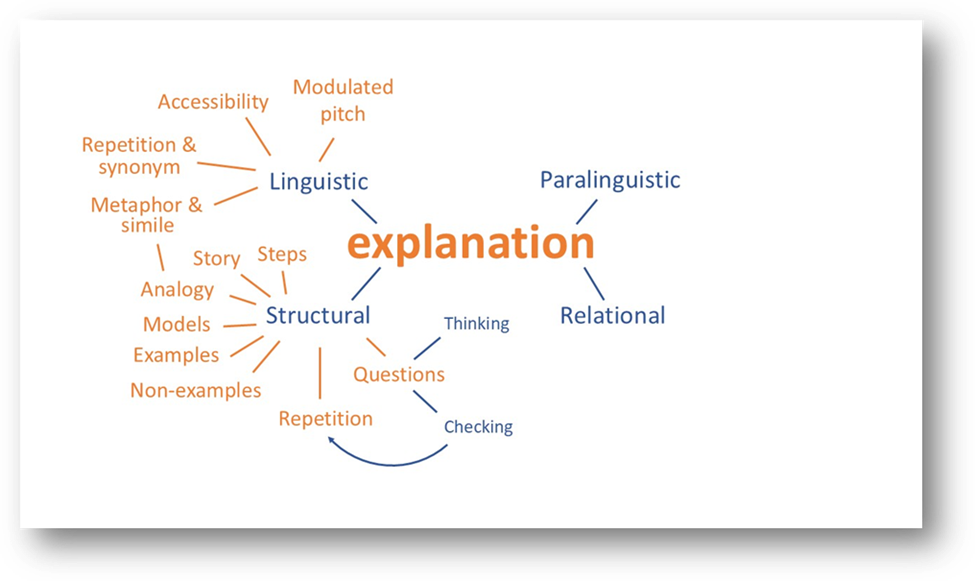
This use of metaphor, rooted in strong subject knowledge, links to one of the key structural elements of explanation – analogy. Teachers become skilled at finding relatable comparisons to make sense of tricky ideas. So electrical current is like water flowing through pipes, or equations are like balancing a scale. Related to this, teachers use models – simplified version of reality, such as a basic flow-diagram to represent the water cycle. Also related, teachers know the power of story in explanation. They may turn processes into narratives, or they tell stories as examples, examples (and non-examples) being central to most explanations. Other structural elements include the sequencing of steps towards understanding, and the repetition of key elements. And another might be the use of questions – to stir the thinking required to make sense of an idea, as well as to check on understanding. These are the mechanics of explanation.
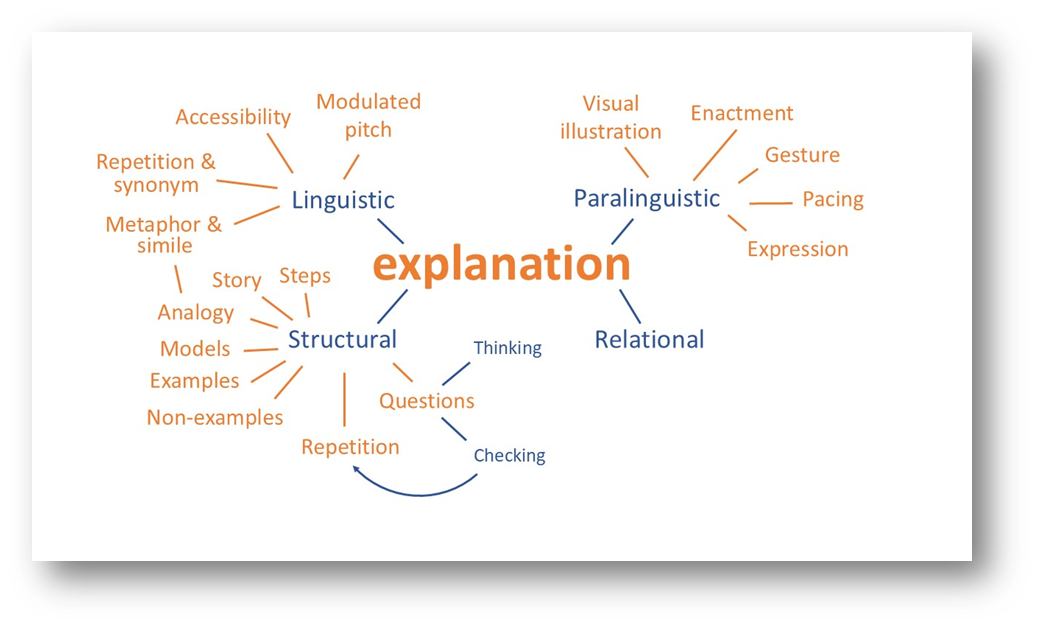
Teachers, of course, deploy a range of what might be called paralinguistic strategies to support, complement and reinforce understanding. Obvious ones are illustrations, diagrams and other visual devices. Like models, examples, analogies and metaphors, these visual representations are another way in which teachers make the abstract concrete. And they may just be air-drawn: we often ask listeners to visualise what isn’t actually there. If you watch teachers, they are often illustrating ideas with gestures and – as these grow more elaborate or pronounced – a sort of enactment. Then there is the use of pacing to emphasise ideas or focus attention, and of expression to guide attention to particular words and phrase, or to colour them with significance.
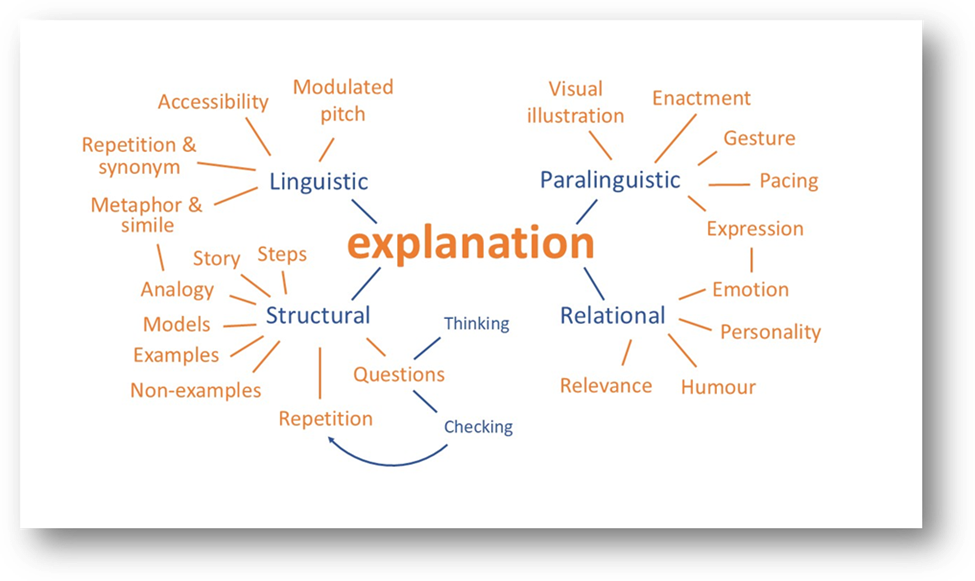
This is where the mechanics of explanation starts to overlap with what might be called the relational dimension. Of course, all the linguistic and structural elements depend not just on knowledge of the subject, but on knowledge of the listeners – of the pupils in the classroom – of what they will already know, what they need, and what they will respond to. But successful explanation also taps into the relationship between teacher and pupils. It is about emotion – communicating the affective dimension of what is being explained (excitement, intrigue, wonder, seriousness, revulsion or horror) and communicating the pleasures and satisfactions of understanding itself. It is about humour, which is such a powerful way to open receptiveness, to secure investment and to trigger connections. And it is about making ideas personally relevant, as in relatable to.
When you watch a very successful ‘explainer’ like Brian Cox, it is obvious how important this relational dimension is. In this clip, many of the mechanical elements above are evident: there is metaphor, modelling, story-making, sequencing of steps, repetition, and there is gesture, enactment, visualisation. But there is also emotion, personality and connection – all driving us to invest, and to feel that we are sharing in understanding.
In the case of a TV presenter, this is what’s termed a para-social relationship. In the classroom, it is a real one. And, combined with strong subject knowledge and dexterity in the mechanics of explanation, it is often relationship which seems to make classroom explanation successful – to make understanding sticky and to make ideas feel relevant.
The idea of relevance in the classroom is often tutted at, as connoting low expectations and the avoidance of difficulty. But making relevant is really about making relatable.
I have always remembered one example – trivially simple, really – from about 45 years ago, when my geography teacher used his own car as an example when explaining the concept of a ‘system’. The joke was that it was debatable whether his famously unreliable Hillman Hunter had outputs as well as inputs – whether it was an example or a non-example. Tapping into a running joke, humour and familiarity coincided neatly with concept, self-deprecation secured my investment, and a very long-term memory was formed.

As a beginning teacher in St Neots, I remember explaining Macbeth’s line “I am in blood / Stepp’d in so far that, should I wade no more, / Returning were as tedious as go o’er”, to a challenging Year 10 group. Many of them walked to school across the Coneygear area of St Neots, which frequently flooded, forcing them either to wade or to be late. It’s a terrible teaching cliché, but I really do remember seeing the light come on in faces, when I asked them to imagine the Coneygear flooded with blood.

Again, to teachers this pedagogical trick will seem trivially ordinary. And that is because teachers are experts in connection – in finding ways (in the moment) to make the unfamiliar relatable, and to turn learning into something personal – into shared, pleasurable meaning-making.
See also: Modelling and how to plan for it
See also: ‘Adaptive teaching’: what does it mean in practice?
See also: Staying invested


Leave a comment