
A lot is being written and published at the moment on adaptive teaching, and particularly on how ‘checking for understanding’ happens in classrooms.
It strikes me that some of the discourse risks overcomplicating what (if it is to be applied) needs to feel manageable and intuitive. I probably overcomplicated things a bit myself in this suggested tool for reflecting on adaptive teaching practice, although I still think my diagram is a useful conceptual summary:
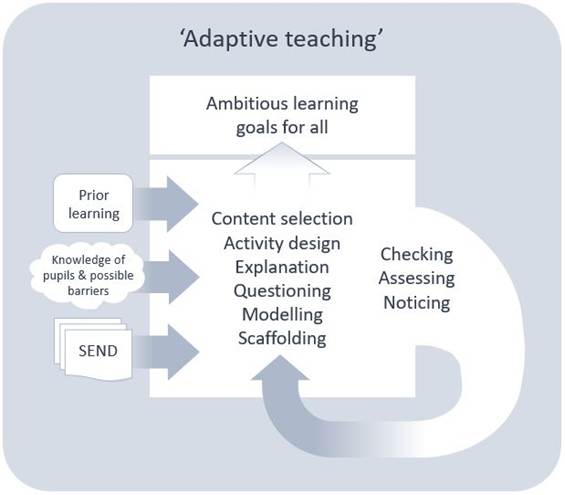
The looping bit is, of course, key. This is the responsiveness – the in-the-moment adaptiveness – the altering of inputs according to how pupils seem to be learning.
This is where ‘checking for understanding’ comes in, and it sounds simple, but it too can be over-theorised and made over-complicated. Also, the term ‘checking for understanding’ can suggest something deliberate, conscious and definitive, which may not always be appropriate.
When I discuss lessons I’ve watched, I often come back to the idea of ‘feedback loops.’ Simply: are such loops operating in the lesson?
I talk about these as being, broadly, either ‘events’ or ‘organic’.
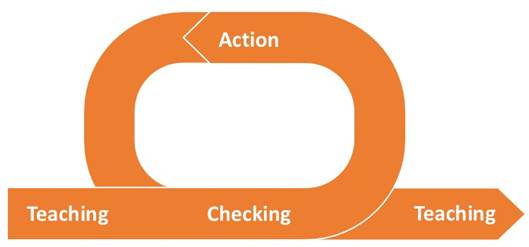
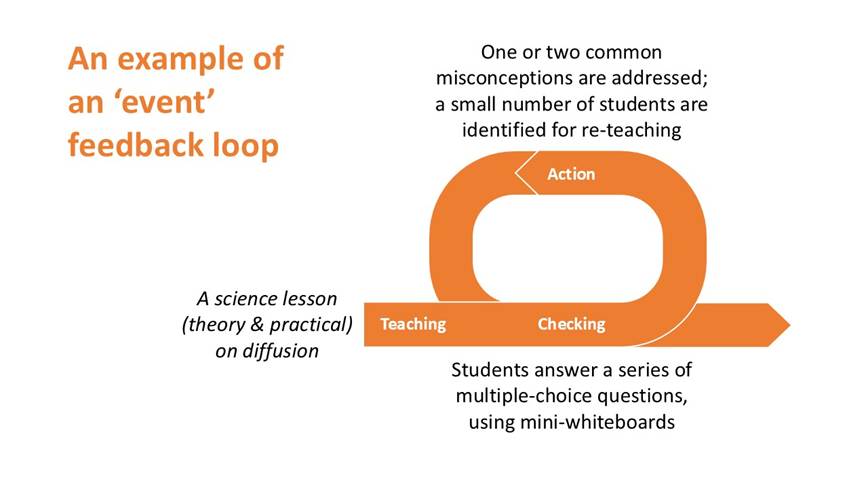
Some feedback loops are ‘events’. These are the visible ‘I am now checking for understanding’ activities, like quizzes, cold-calling, answering questions on mini-whiteboards, short paper-based tasks, multiple-choice questions, and so on. They punctuate lessons, and they are followed by clear teacher actions, such as the addressing of a misconception, the deliberate re-explaining or re-teaching content, the identification of a group who need further breaking down of material or more scaffolding, the revisiting of prior learning, extra modelling, or the injection of new challenge – perhaps by exploring new, tangential or related ideas.
But much checking is ‘organic’, and might actually not feel like ‘checking’ at all. Rather than visible, punctuating events it is folded into teaching and into activities. It is about noticing (perhaps from a distance), circulating while pupils are working, listening to pupils talking to each other, engaging in conversation with the class, groups or individuals and asking follow-up questions.

Again, this checking may lead, necessarily, to the sort of structural interventions listed above. But it may also lead to more organic actions, less obvious to an observer, such as the offering of private praise and encouragement, an alteration of lesson pace to slow or accelerate learning, prompting, clueing and nudging towards better or deeper understanding, responding to pupils in dialogue, asking follow-up questions which extend or deepen students’ thinking, subtly adjusting goals and challenges, sensitive correction of errors and attention to individuals’ specific needs.
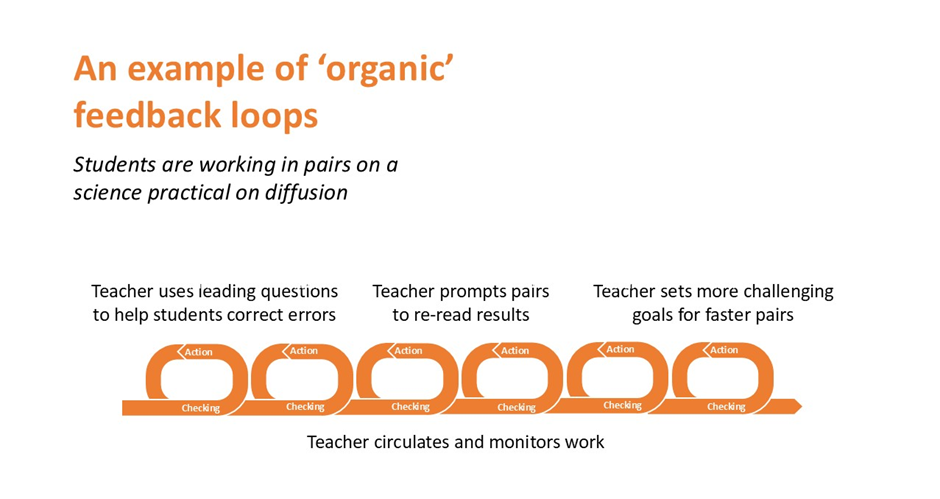
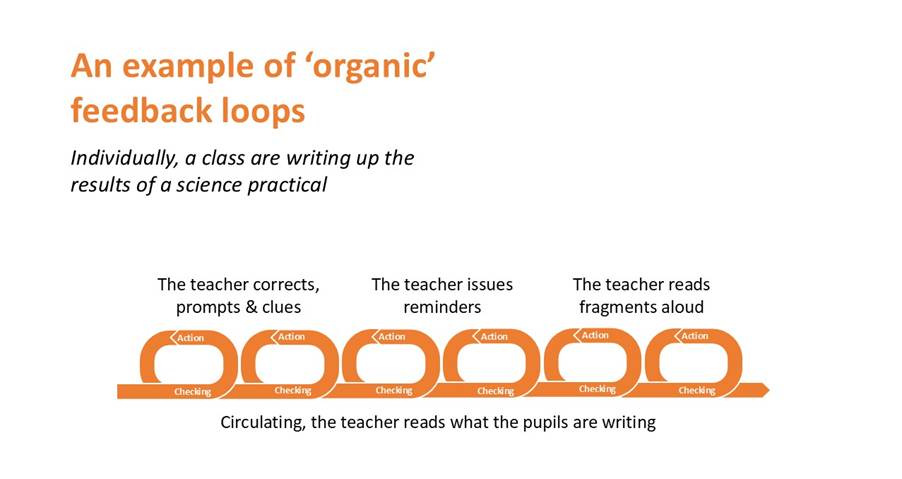
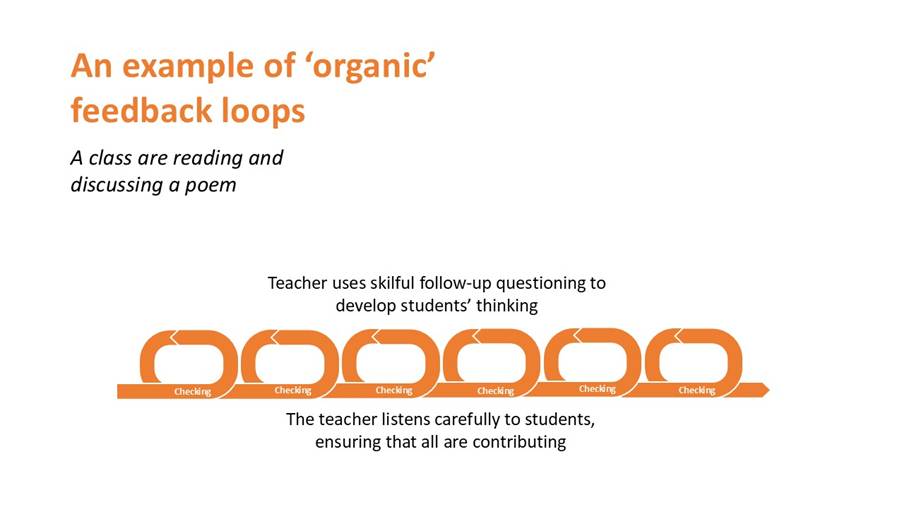
I think these organic processes, often less visible and more subtle, can be a little neglected in discussions of ‘checking for understanding’. If, instead of thinking ‘When shall I check for understanding in this lesson?’, we think ‘How will feedback loops be operating in this lesson?’, then it can potentially result in better teaching.
If a school has a learning walk proforma, and it has a tick-box for ‘checking for understanding’, the temptation for teachers will always be to demonstrate this with a lesson-punctuating event. That may well be appropriate, but my suggestion is to look for ‘feedback loops’ instead.
See also: ‘Adaptive teaching’: what does it mean in practice?
See also: Folding feedback into learning
See also: Key learning questions – an introduction
See also: Who is doing what in the classroom? A tool for planning and reflection


Leave a comment