

Recently, I have had a number of conversations with secondary school leaders about exam readiness. The last few years have a seen an important focus on curriculum and its implementation. But some dips in the 2023 results, as well as Ofsted’s announced emphasis on data, have led in many schools to a renewed, pragmatic focus on how to maximise outcomes.
This blog offers a simple framework to support a strategic review of how students are readied for exams. (Download here.) It contains nothing that isn’t familiar and it is undoubtedly incomplete; but some schools have found useful by some as a tool for reflecting holistically on practice, in search of those all-important marginal gains. (It is designed around GCSEs, but the principles apply to post-16 exams too.)
An holistic approach
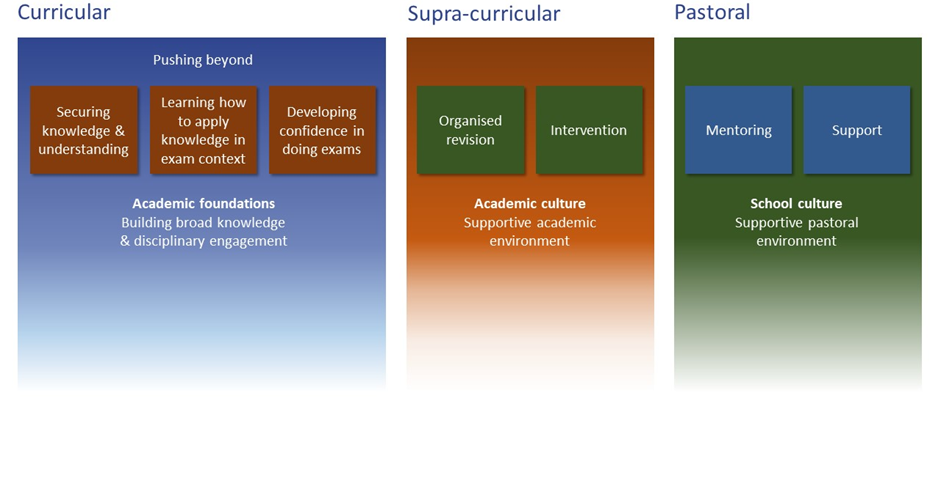
The suggestion is that successful exam preparation is about the working in combination of three essential aspects: the curricular, the ‘supra-curricular’ and the pastoral, each of which is about culture, as well as about planned actions. (Click to expand graphics.)
What’s in the curriculum?
At the heart, of course, is the securing of students’ knowledge and understanding. Reviewing this is about checking the design of Key Stage 4, how well content is layered through it, revisited and revised, spaced and interleaved. It is about how sequencing is kept flexible, and how teaching is kept responsive to assessment. It is also about how knowledge is being effectively captured and recorded and put at students’ fingertips. This is the element which subject teams and line-managers will pick over most forensically.
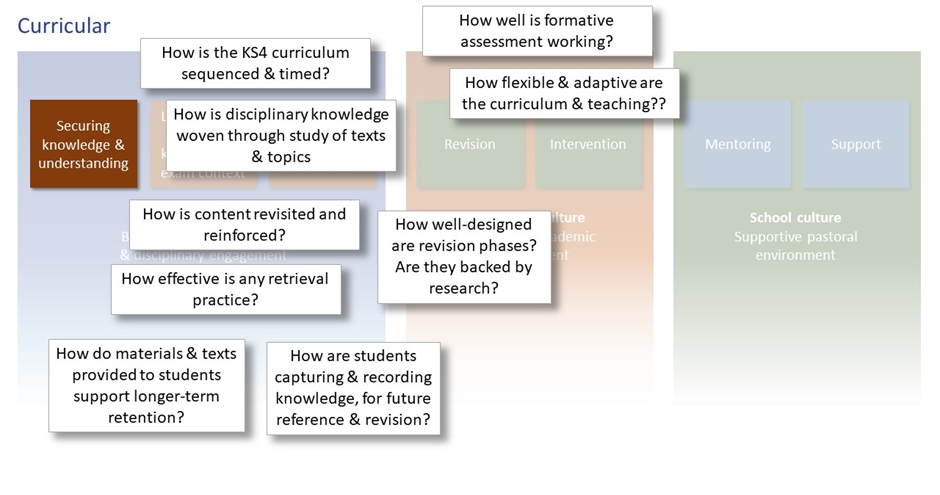
But they will also review how, pragmatically, students are learning to apply this knowledge in the specific ways demanded by assessment, such as in answering exam questions. They will review how well this is taught explicitly, and how effectively it is woven organically into teaching over time, so that students are becoming fluent in the particular kinds of thinking and response required.

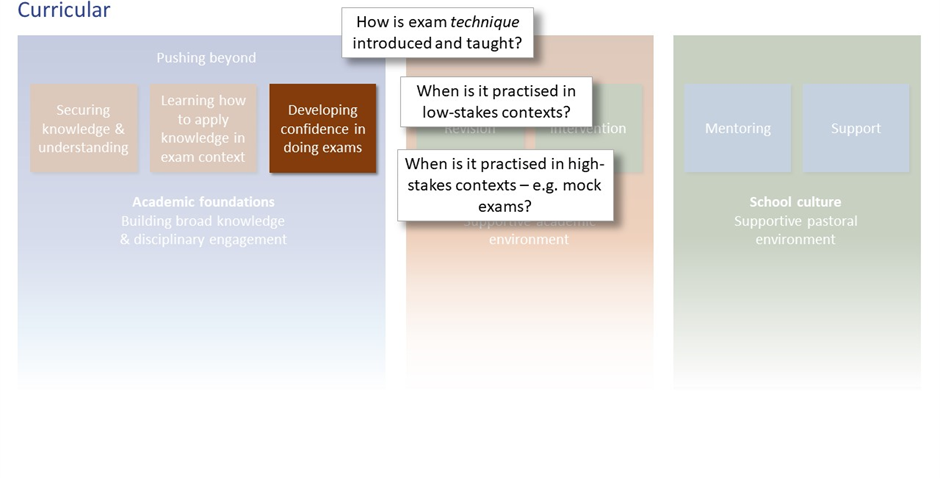
Connected to this, there is the way students are helped, within each discipline, to gain confidence in actually undertaking exams – in navigating papers, in decoding questions and in managing time – in performing their knowledge and their skills. This will include the way exam practice – both high and low-stakes – is designed in to the curriculum.
But underlying and surrounding all of this are the academic foundations laid within the curriculum. This is about the depth, richness and enjoyment of learning across subjects. It is about how students are continuing to develop a breadth of knowledge, beyond the specifications themselves. And it is about how Key Stage 3 is laying true disciplinary foundations, not just a junior version of GCSE courses.
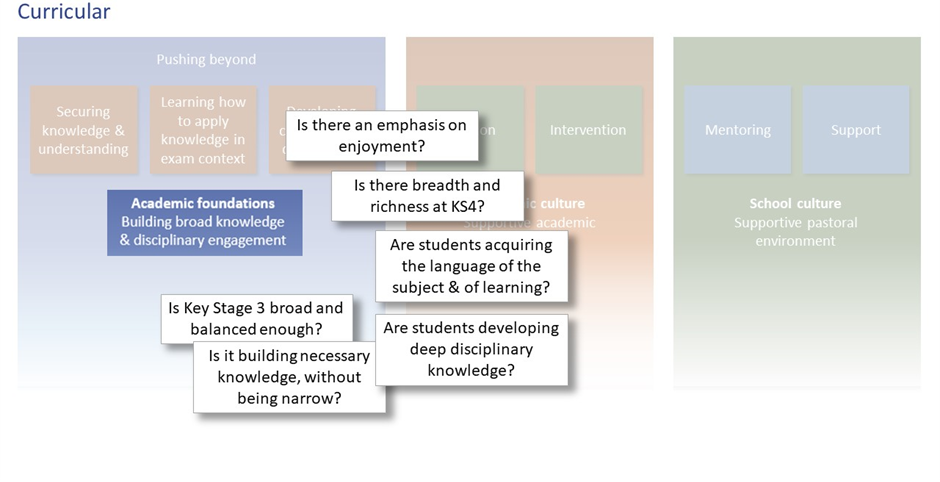
And there’s also the element of upward ambition – of deliberate over-reach – of pushing beyond, to ensure that the highest attaining students can achieve, and to keep pitch and expectations as high as possible.

What’s happening on top?
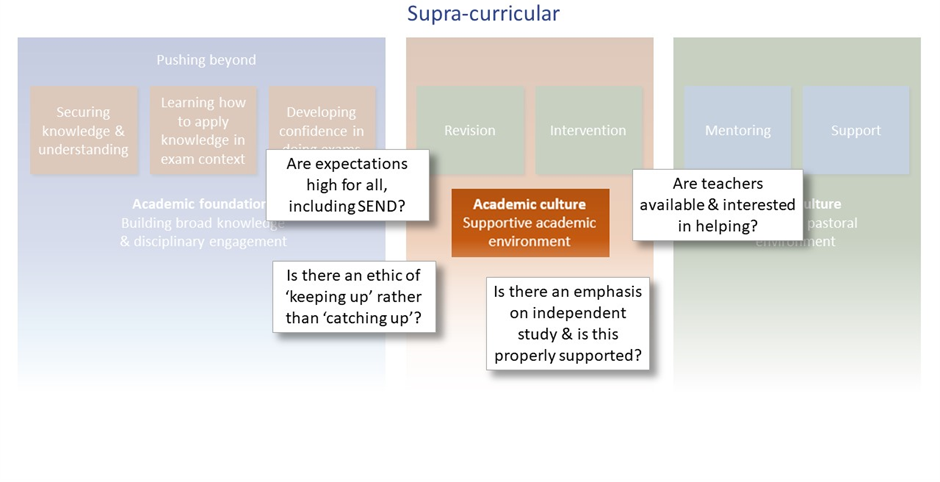
In addition to the regular curriculum, there is what might be called the ‘supra-curricular’ offer – the programme of extra, organised revision sessions, and the various targeted interventions. Are these having their intended impact, and how is this ascertained? How well timed and targeted are they? And how expert and evidence-led is their delivery?

And there is the general academic culture, within which all students are made ready. This is about ethos and expectations, the availability and enthusiasm of teachers, and the way habits of independent study have been and continue to be built. It’s about the academic ‘buzz’ promoted through assemblies, form time and other messaging.
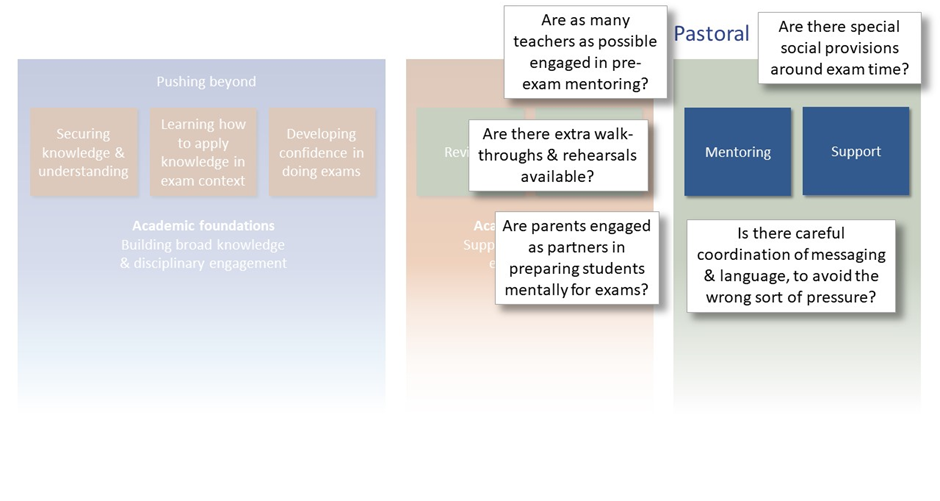
How are students looked after?
Then there is the pastoral element – the targeted mentoring and support for individual students and groups, the providing of reassurance and of refuge when necessary, the providing of extra, confidence-building rehearsals, the engagement of parents, and the careful moderation of messages to students, to avoid overload and to mitigate for anxiety.
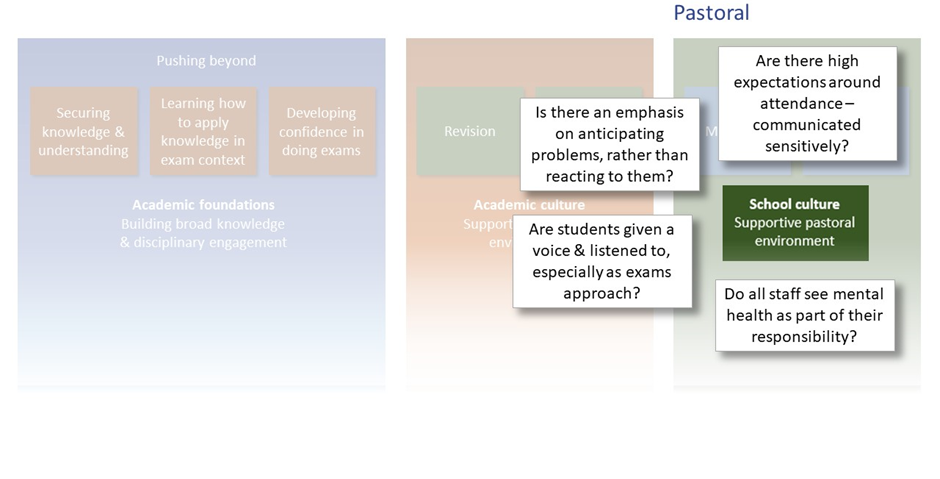
And there’s the more general pastoral environment across the school, and how well this supports all students as they turn into exam candidates, rather than just learners – the way problems are anticipated and pre-empted, how students are made to feel involved and listened to, how staff prioritise mental health and wellbeing, and – of course – how students are encouraged positively to attend school.
 James Durran
Leave a comment