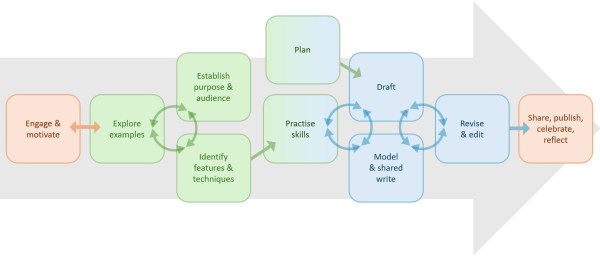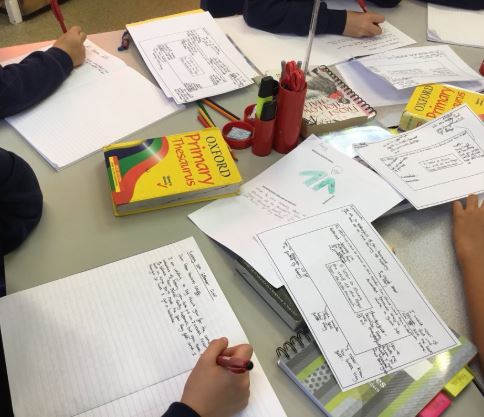
This is an example of an approach to a text, which is designed specifically to help all pupils to develop their writing of literary narrative without recourse to the ‘features of descriptive writing’ or to checklists of literary devices. Over a series of sessions, it integrates whole-class reading practice with the planning and drafting of... Continue Reading →
Re-thinking ‘success criteria’: a simple device to support pupils’ writing
Colleagues and I have been working with primary schools to develop an alternative to listed ‘success criteria’ for writing, which we call ‘boxed’ or ‘expanding success criteria' (or often just 'the rectangles thing.') It is very easy to adopt, and teachers have been finding that it can transform how writing is talked about and approached... Continue Reading →
The importance of ‘extended writing’
Some thoughts on task-setting and assessment in English, especially at Key Stage 3 In a well-planned Key Stage 3 course on Of Mice and Men, pupils will be gripped by and immersed in Steinbeck’s novel, will enter imaginatively into the world of the story, will explore its context and significance, will investigate ways in which... Continue Reading →
Googling for originality
A simple classroom technique, when drafting and editing. Recently, I have been doing quite a bit of drafting and editing of creative writing with Year 5 and 6 pupils, and I have been finding this little game useful. I'm sure it's not original, and I have used it with older students since search engines became a... Continue Reading →
Marking for ‘literacy’ – problems with ‘codes’
Number #4 in an occasional series of short posts about feedback, appearing in no particular order. In many schools, there is a literacy ‘marking code’ by which all teachers are meant to abide. Typically, spelling errors are marked with an ‘S’, punctuation errors with a ‘P’ and so on. Some of these codes are highly... Continue Reading →
Memorable feedback: the power of spoken comments
Number #3 in an occasional series of short posts about feedback, appearing in no particular order. When I was 11 or 12, I did this piece of creative writing for homework. It's called ‘An Angry Traffic Warden’. This was the written feedback which I received: There was clearly a process here: the mark had... Continue Reading →
What does the poem do? A revision tool
This is an approach which I have used successfully when revising clusters of poetry for GCSE. (Apologies for any parts which seem commonplace or obvious.) The basic idea is familiar - to practise summing up the ‘essence’ of each poem, so that students feel that they have a pinned-down overview of each – a handy... Continue Reading →
Written comments: three simple rules (and a fourth)
Number #1 in an occasional series of short posts on feedback, appearing in no particular order
Objectives and purpose in English
Thoughts on learning objectives and on the way we frame learning in English