
‘Reading for pleasure’ is suddenly a topic of lively and interesting debate. What is it? What should ‘it’ be called? What is its value? Where should it sit within education?
The discussion is focused on the various forms of volitional reading which pupils do on their own. But what about the reading which isn’t volitional, which pupils do in all subjects?
When I run training on disciplinary literacy, I often use this slide.
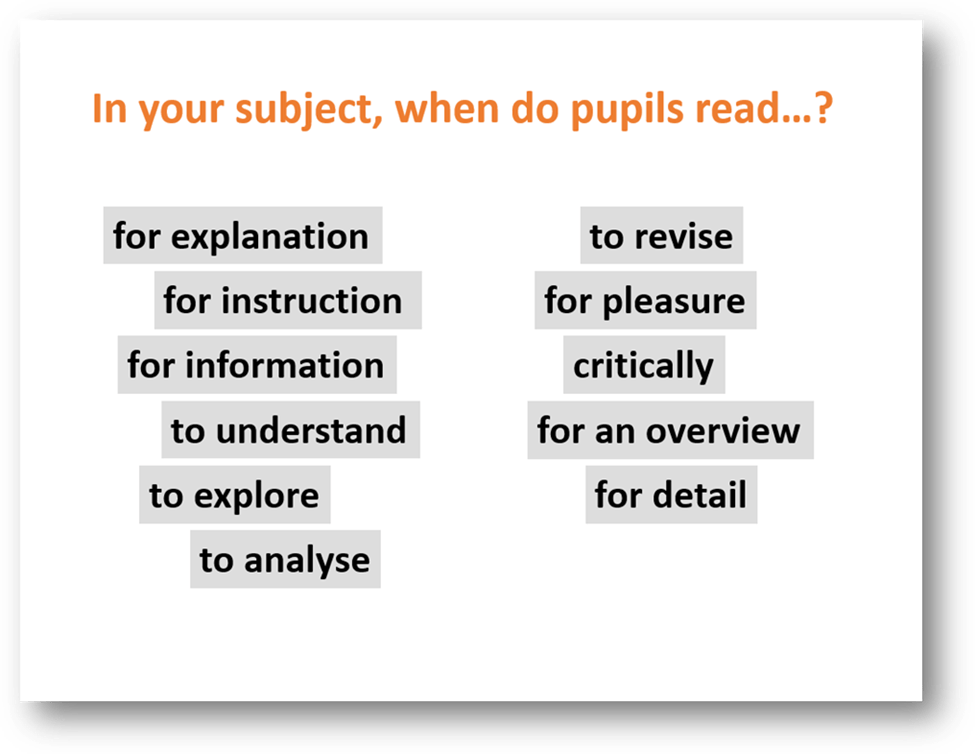
The only teachers who ever say that pupils read for pleasure in their subject are English teachers, and even they tend to see this as synonymous with ‘private’ or ‘independent’ reading.
This leads into a discussion of why. As subject specialists, teachers agree that there are lots of pleasures in reading within their own disciplines. But the framing of reading in lessons rarely foregrounds, or even alludes to, these pleasures.
My suggestion is that, when we ask pupils to read in lessons, we adapt our language to suggest that reading brings pleasure – that it is interesting, satisfying, exciting or fun, rather than just required.
Don’t say:
“Before we… we have to read…”
“I want you to read…”
“You need to read…”
“Let’s get this read, so that…”
Instead, say:
“Right, now we get a chance to read…”
“Now, enjoy the way this writer…”
“There are some exciting ideas here, so…”
“I really like the way this…”
“Look at this page. When I read this, I enjoyed…”
And, while reading, say…
“That is SO interesting.”
“I like the way this…”
“What a great explanation.”
“That’s fun!”
 James Durran
Leave a comment