Thoughts on what keeps pupils learning through a lesson, and why this might be difficult for the robot teachers of the future A few years ago, I wrote something about engagement, suggesting that saying pupils are โinvestedโ rather than just โengagedโ implies that they are more than just on task. The question โHow will you... Continue Reading →
Disciplinary literacy: reading a challenging text in the classroom
This post unpacks a typical approach to reading a challenging text, in this case in a geography lesson. It also describes a number of practices associated with strong โadaptive teachingโ. Reading challenging texts in the classroom It is notoriously difficult in secondary schools for strong disciplinary literacy practices to become established across the curriculum, for... Continue Reading →
Key learning questions โ an introduction
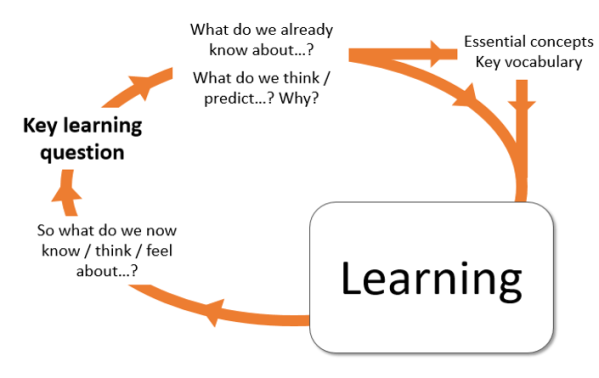
A โkey learning questionโ is simply a way of framing the learning in a lesson or across a sequence of lessons โ of setting the learning agenda for pupils. It is an alternative to the traditional โlearning objectiveโ, replacing a statement of what pupils will learn, or of what they will aim to learn, with... Continue Reading →
Quick talk about texts
Short-burst pair or group talk activities which can be woven into reading lessons Inย other posts, I've suggested that the most effective whole-class reading sessions allow for seamless weaving together of whole-class discussion, individual thinking time and pair or small group talk. below are some examples of typical, short pair or group talk activities (30 seconds... Continue Reading →
Whole-class reading: a planning tool
See also Whole-class reading: an example lesson and a menu of approachesย ย andย Whole-class reading: another example lesson Recently, colleagues and I have been working hard with schools to develop whole-class reading practice which is both challenging and inclusive. This is a particularly current issue in primary schools, but is - of course - also pertinent to... Continue Reading →
Fear of grammar and the grammar of fear
Injecting challenge at Key Stages 3 and 4, using Key Stage 2 knowledge about grammar The not-so-new-now grammar curriculum at Key Stage 2 has resulted in pupils arriving in secondary school with a knowledge of grammatical terms which, even to some specialist English teachers, can be a little intimidating. It can also be confusing to... Continue Reading →
Whole-class reading: another example lesson
See also: Whole-class reading: a planning tool A description of a recent whole-class reading lesson, with commentary This is a description of another successful whole-class reading lesson which I taught recently to Year 4 and Year 5 classes (although the approaches are applicable to other phases.) It is a follow-up to a post last year... Continue Reading →
Challenging responses: designing a successful teacher-led reading lesson
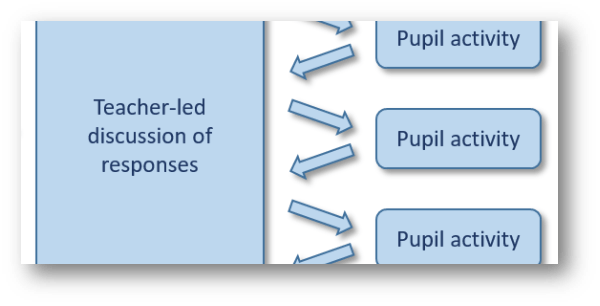
A reflection on some different ways to structure discussion of a text in the classroom. The example is from Key Stage 3, although the principles are applicable to any phase. The text below is one which we used to read with Key Stage 3 pupils at Parkside Community College, in Cambridge, when teaching about World... Continue Reading →
Mini-whiteboard jigsaws
An organising technique and resource for discussion. Good for revision, for practising retrieval and for deepening thinking. (Good for all ages, too.) Step 1 Using sharp scissors, cut up some mini-whiteboards to make a set of unique, four-piece jigsaws, like this. (This is surprisingly quick and easy to do, and oddly satisfying.) You now have... Continue Reading →
Whole-class reading: an example lesson and a menu of approaches
See also:ย Whole-class reading: a planning tool See also:ย Whole-class reading: another example lesson See also:ย Challenging responses: designing a successful teacher-led reading lesson In primary schools recently, there has been a lot of interest in ways to approach whole-class reading lessons. The imperative to raise standards in reading is leading many to question the dominance of... Continue Reading →