Exam readiness – a tool for reflecting on culture and practice

Recently, I have had a number of conversations with secondary school leaders about exam readiness. The last few years have a seen an important focus on curriculum and its implementation. But some dips in the 2023 results, as well as Ofsted’s announced emphasis on data, have led in many schools to a renewed, pragmatic focus... Continue Reading →

Lost queens and dodos: some reflections on knowledge, comprehension and how we teach reading

Reading is built on knowledge. But it’s a bit more complicated than that. This post was co-written with Barbara Bleiman (@BarbaraBleiman), and is also published on the English and Media Centre blog. In 2016, the passages on the new-look Key Stage 2 ‘Reading’ test caused some controversy, seen by many as being too demanding for... Continue Reading →

Re-thinking ‘success criteria’: a simple device to support pupils’ writing

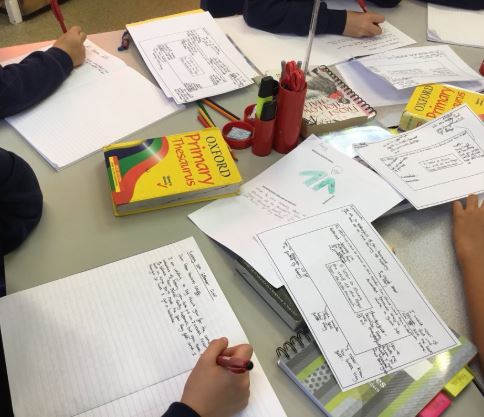
Colleagues and I have been working with primary schools to develop an alternative to listed ‘success criteria’ for writing, which we call ‘boxed’ or ‘expanding success criteria' (or often just 'the rectangles thing.') It is very easy to adopt, and teachers have been finding that it can transform how writing is talked about and approached... Continue Reading →

Avoiding a ‘literacy dip’ in Year 7

Some questions for secondary teachers, English teams and school leaders, which may be helpful Many secondary schools have concerns about how to maintain progress in the core area of literacy from Year 6 to Year 7, perceiving that many students do not make sufficiently-strong progress in Year 7, or that they can even regress in... Continue Reading →

The importance of ‘extended writing’

Some thoughts on task-setting and assessment in English, especially at Key Stage 3 In a well-planned Key Stage 3 course on Of Mice and Men, pupils will be gripped by and immersed in Steinbeck’s novel, will enter imaginatively into the world of the story, will explore its context and significance, will investigate ways in which... Continue Reading →

Being ‘good at English’

Some possible 'qualities' of excellence in English There has been some discussion recently on blogs and Twitter about what it means to be ‘good at English’. Often, this is in the context of thinking about progression – from Key Stage 3 to 4, or from GCSE to A-Level, for example: what should we be aiming... Continue Reading →

Post-Levels: tracking progress in English at Key Stage 3

Thoughts on how schools are assessing progress and attainment in English at Key Stage 3 This post is based very closely on an original article for NATE‘s Teaching English (Issue 8, Summer 2015) Post-levels, it has been left to schools to decide on how to track progress at Key Stage 3. A number of teaching schools […]

Missing open book exams

Thoughts on ‘closed book’ and 'open book' exams Parliament has debated whether students should continue to be allowed only ‘closed book’ exams in GCSE English and English Literature. (Really, of course, they are ‘absent book’ exams. Closed books would just be cruel.) The arguments for ‘closed book’ exams – now dominant at GCSE, AS and... Continue Reading →

Start a Blog at WordPress.com.

Up ↑