This post unpacks a typical approach to reading a challenging text, in this case in a geography lesson. It also describes a number of practices associated with strong ‘adaptive teaching’. Reading challenging texts in the classroom It is notoriously difficult in secondary schools for strong disciplinary literacy practices to become established across the curriculum, for... Continue Reading →
Modelling and how to plan for it
The current focus on ‘adaptive teaching’ has meant that the craft (or art) of teacher modelling has rightly been foregrounded, as a crucial mechanism for making learning accessible. Interestingly, when I am asked after seeing a lesson to comment on how learning might have been more successful, modelling is probably the most common element I... Continue Reading →
Exam readiness – a tool for reflecting on culture and practice
Recently, I have had a number of conversations with secondary school leaders about exam readiness. The last few years have a seen an important focus on curriculum and its implementation. But some dips in the 2023 results, as well as Ofsted’s announced emphasis on data, have led in many schools to a renewed, pragmatic focus... Continue Reading →
The power of exploratory writing
The piece below was written many years ago by a Year 9 pupil, Kanika, for a colleague of mine (@craigbmorrison) at Parkside Community College, Cambridge. It illustrates, I think, some features of what might be termed ‘exploratory’ writing – developing response, understanding and expression without recourse to P.E.E or P.E.T.A.L. or other formulae, and without... Continue Reading →
Fear of grammar and the grammar of fear
Injecting challenge at Key Stages 3 and 4, using Key Stage 2 knowledge about grammar The not-so-new-now grammar curriculum at Key Stage 2 has resulted in pupils arriving in secondary school with a knowledge of grammatical terms which, even to some specialist English teachers, can be a little intimidating. It can also be confusing to... Continue Reading →
Challenging responses: designing a successful teacher-led reading lesson
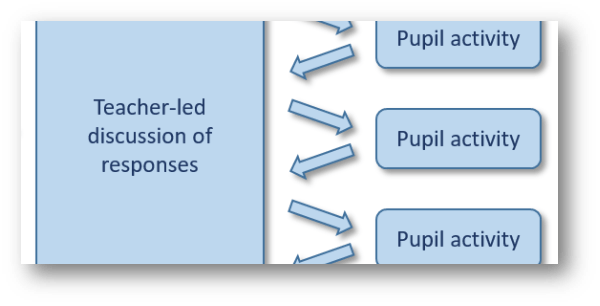
A reflection on some different ways to structure discussion of a text in the classroom. The example is from Key Stage 3, although the principles are applicable to any phase. The text below is one which we used to read with Key Stage 3 pupils at Parkside Community College, in Cambridge, when teaching about World... Continue Reading →
Mini-whiteboard jigsaws
An organising technique and resource for discussion. Good for revision, for practising retrieval and for deepening thinking. (Good for all ages, too.) Step 1 Using sharp scissors, cut up some mini-whiteboards to make a set of unique, four-piece jigsaws, like this. (This is surprisingly quick and easy to do, and oddly satisfying.) You now have... Continue Reading →
Avoiding a ‘literacy dip’ in Year 7
Some questions for secondary teachers, English teams and school leaders, which may be helpful Many secondary schools have concerns about how to maintain progress in the core area of literacy from Year 6 to Year 7, perceiving that many students do not make sufficiently-strong progress in Year 7, or that they can even regress in... Continue Reading →
The importance of ‘extended writing’
Some thoughts on task-setting and assessment in English, especially at Key Stage 3 In a well-planned Key Stage 3 course on Of Mice and Men, pupils will be gripped by and immersed in Steinbeck’s novel, will enter imaginatively into the world of the story, will explore its context and significance, will investigate ways in which... Continue Reading →
‘In this school, English is about…’
Practical tools for reflecting on the what, why and how of English teaching A friend’s nephew, when in Year 8, remarked to him: “I used to enjoy English, but all we do now is write PEE paragraphs.” If this is a pupil’s view (even an unfair one) of English in their school, then something has... Continue Reading →