Classroom strategies for the explicit teaching of spoken expression When we think about how to develop pupils’ talk in the classroom, it is natural to focus on the ‘opportunities’ we're providing for pupils to practise speaking. We also know that developing vocabulary and subject knowledge, the raw material for talk, is key. These are essential,... Continue Reading →
Quick talk about texts
Short-burst pair or group talk activities which can be woven into reading lessons In other posts, I've suggested that the most effective whole-class reading sessions allow for seamless weaving together of whole-class discussion, individual thinking time and pair or small group talk. below are some examples of typical, short pair or group talk activities (30 seconds... Continue Reading →
Challenging responses: designing a successful teacher-led reading lesson
A reflection on some different ways to structure discussion of a text in the classroom. The example is from Key Stage 3, although the principles are applicable to any phase. The text below is one which we used to read with Key Stage 3 pupils at Parkside Community College, in Cambridge, when teaching about World... Continue Reading →
Mini-whiteboard jigsaws
An organising technique and resource for discussion. Good for revision, for practising retrieval and for deepening thinking. (Good for all ages, too.) Step 1 Using sharp scissors, cut up some mini-whiteboards to make a set of unique, four-piece jigsaws, like this. (This is surprisingly quick and easy to do, and oddly satisfying.) You now have... Continue Reading →
Making the investment
Reframing ‘engagement’ in the classroom Any mention of ‘engagement’ in the education Twittersphere or blogosphere will create a flurry of emotive debate. To many, it is now a dirty word, summoning up caricatures of content-free, gimmick-laden teaching, in which the aim is simply to engage so that learning somehow follows. In fact, there is a... Continue Reading →
Asking real questions in the classroom
One of the main ways in which teachers ‘give’ feedback to pupils is through follow-up questioning. This is sometimes the case in written feedback, but is particularly the case in oral feedback, as part of dynamic classroom teaching, in which feedback is folded into learning and is indistinguishable from the discussion and exploration of ideas. It... Continue Reading →
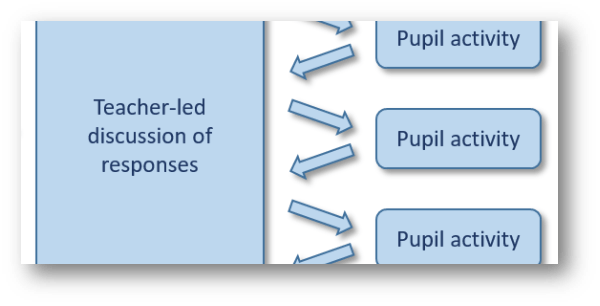
Who is doing what in the classroom? A tool for planning and reflection
It is always risky to discuss something as complex as teaching and learning in terms of any sort of ‘model’. It is always reductive and probably wrong. However, at the moment I am finding it useful to think of classroom teaching working like this. (Click to enlarge) Based on well-rehearsed principles, this schematic might be... Continue Reading →