
A brief post on getting pupils to pay attention Pupils do a lot of listening in classrooms – to explanations, information, narratives, arguments, model answers, feedback, dialogues, other pupils’ contributions and interactions, instructions, advice or guidance, and so on. Listening as behaviour Interestingly, listening is often framed as simply something which pupils are either doing... Continue Reading →
Teaching talk

Classroom strategies for the explicit teaching of spoken expression When we think about how to develop pupils’ talk in the classroom, it is natural to focus on the ‘opportunities’ we're providing for pupils to practise speaking. We also know that developing vocabulary and subject knowledge, the raw material for talk, is key. These are essential,... Continue Reading →
Quick talk about texts

Short-burst pair or group talk activities which can be woven into reading lessons In other posts, I've suggested that the most effective whole-class reading sessions allow for seamless weaving together of whole-class discussion, individual thinking time and pair or small group talk. below are some examples of typical, short pair or group talk activities (30 seconds... Continue Reading →
Reading as writers; writing as readers: an account of a Year 5/6 teaching sequence

This is an example of an approach to a text, which is designed specifically to help all pupils to develop their writing of literary narrative without recourse to the ‘features of descriptive writing’ or to checklists of literary devices. Over a series of sessions, it integrates whole-class reading practice with the planning and drafting of... Continue Reading →
Whole-class reading: a planning tool

See also Whole-class reading: an example lesson and a menu of approaches and Whole-class reading: another example lesson Recently, colleagues and I have been working hard with schools to develop whole-class reading practice which is both challenging and inclusive. This is a particularly current issue in primary schools, but is - of course - also pertinent to... Continue Reading →
Whole-class reading: another example lesson

See also: Whole-class reading: a planning tool A description of a recent whole-class reading lesson, with commentary This is a description of another successful whole-class reading lesson which I taught recently to Year 4 and Year 5 classes (although the approaches are applicable to other phases.) It is a follow-up to a post last year... Continue Reading →
Challenging responses: designing a successful teacher-led reading lesson
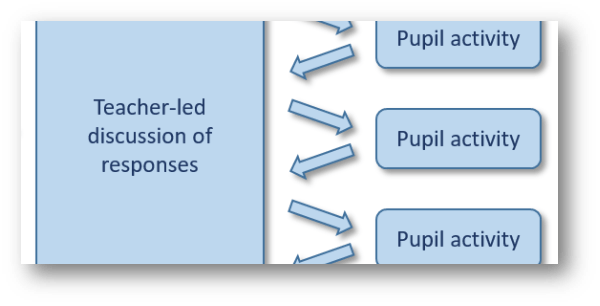
A reflection on some different ways to structure discussion of a text in the classroom. The example is from Key Stage 3, although the principles are applicable to any phase. The text below is one which we used to read with Key Stage 3 pupils at Parkside Community College, in Cambridge, when teaching about World... Continue Reading →
Mini-whiteboard jigsaws
An organising technique and resource for discussion. Good for revision, for practising retrieval and for deepening thinking. (Good for all ages, too.) Step 1 Using sharp scissors, cut up some mini-whiteboards to make a set of unique, four-piece jigsaws, like this. (This is surprisingly quick and easy to do, and oddly satisfying.) You now have... Continue Reading →
Whole-class reading: an example lesson and a menu of approaches

See also: Whole-class reading: a planning tool See also: Whole-class reading: another example lesson See also: Challenging responses: designing a successful teacher-led reading lesson In primary schools recently, there has been a lot of interest in ways to approach whole-class reading lessons. The imperative to raise standards in reading is leading many to question the dominance of... Continue Reading →
Googling for originality

A simple classroom technique, when drafting and editing. Recently, I have been doing quite a bit of drafting and editing of creative writing with Year 5 and 6 pupils, and I have been finding this little game useful. I'm sure it's not original, and I have used it with older students since search engines became a... Continue Reading →
 James Durran