
The primary English subject leader: overseer, monitor, director or trusted expert?

Recently, as part of our work with English subject leaders from across the county, the North Yorkshire English Advisory Team have been looking at how the subject is led differently in primary schools. English or literacy subject leaders tend to be talked about as a group, yet we know that what they actually do varies... Continue Reading →

Whole-class reading: another example lesson

See also: Whole-class reading: a planning tool A description of a recent whole-class reading lesson, with commentary This is a description of another successful whole-class reading lesson which I taught recently to Year 4 and Year 5 classes (although the approaches are applicable to other phases.) It is a follow-up to a post last year... Continue Reading →

Challenging responses: designing a successful teacher-led reading lesson

A reflection on some different ways to structure discussion of a text in the classroom. The example is from Key Stage 3, although the principles are applicable to any phase. The text below is one which we used to read with Key Stage 3 pupils at Parkside Community College, in Cambridge, when teaching about World... Continue Reading →

Whole-class reading: an example lesson and a menu of approaches

  See also: Whole-class reading: a planning tool See also: Whole-class reading: another example lesson See also: Challenging responses: designing a successful teacher-led reading lesson In primary schools recently, there has been a lot of interest in ways to approach whole-class reading lessons. The imperative to raise standards in reading is leading many to question the dominance of... Continue Reading →
The importance of ‘extended writing’

Some thoughts on task-setting and assessment in English, especially at Key Stage 3 In a well-planned Key Stage 3 course on Of Mice and Men, pupils will be gripped by and immersed in Steinbeck’s novel, will enter imaginatively into the world of the story, will explore its context and significance, will investigate ways in which... Continue Reading →

Making the investment

Reframing ‘engagement’ in the classroom Any mention of ‘engagement’ in the education Twittersphere or blogosphere will create a flurry of emotive debate. To many, it is now a dirty word, summoning up caricatures of content-free, gimmick-laden teaching, in which the aim is simply to engage so that learning somehow follows. In fact, there is a... Continue Reading →

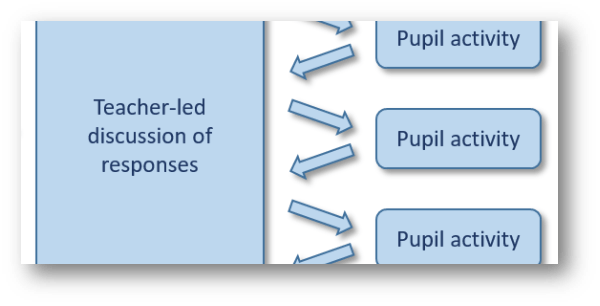
Who is doing what in the classroom? A tool for planning and reflection

It is always risky to discuss something as complex as teaching and learning in terms of any sort of ‘model’. It is always reductive and probably wrong. However, at the moment I am finding it useful to think of classroom teaching working like this. (Click to enlarge) Based on well-rehearsed principles, this schematic might be... Continue Reading →

Developing critical readers: preparing students for GCSE English Language reading papers

Thoughts on how students are taught to write critically about texts in exams This post was originally an article for NATE‘s Teaching English (Issue 12, Autumn 2016) Preparing for the new English GCSEs has compelled English departments to put their Key Stage 4 curriculum through yet another revision. For many, this has been taken as an opportunity […]

Start a Blog at WordPress.com.

Up ↑